What the Flights Land Into
A plane will take off from Miami this morning and land at Cap-Haïtien. Six hundred miles to the south, in the streets beside Port-au-Prince’s international airport, soldiers from another country are patrolling in armoured vehicles. One Haitian diaspora organisation has written to the Secretary-General of the United Nations to say those soldiers bombed civilian neighbourhoods; the president who sent them and the international force they belong to both say that is false.
If you are reading this because you lost Temporary Protected Status, none of that is a message about you. It is not a prediction about you either. It is a description of a place, and the reason to set it out carefully is that people are making decisions about that place right now — whether to send money, whether to put a relative on a plane, whether to go themselves — and the information reaching them is a mixture of things that are verified, things that are only alleged, and things nobody has settled at all.
1. The runway at Cap-Haïtien
American Airlines restarts a daily Miami–Cap-Haïtien service today, Sunday, Nov. 1. The Haitian Times reported the date on Oct. 29, attributing it to an airline spokesperson, and Le Nouvelliste carried it again early this morning.
This page also reported, on Oct. 30, that a failure in the runway lighting system at Cap-Haïtien had disrupted air traffic there two days before that first flight was due. Whether the lighting has been repaired is not something this page can tell you today. The national airport authority’s website could not be reached from here this morning, as it could not be reached yesterday, and no newsroom has published anything about the state of the lights since the failure was reported.
What follows from that is practical, not dramatic. If someone in your family is booked on this route, get the flight status in writing from the airline — not from a relative, not from a social-media post, not from this page — and get it again on the morning of travel. A route that reopens can close again, and a schedule you read online last week is not a confirmation.
And the thing that matters most about a restarting flight is the thing it is easiest to read backwards: a plane flying again is not a statement that it is safe to be on it, and it is not a reason to go. Nobody has to leave. If you are weighing a return, talk to an immigration lawyer first, because leaving the United States can affect whether and when you are able to come back.
2. The soldiers, and what is alleged about them
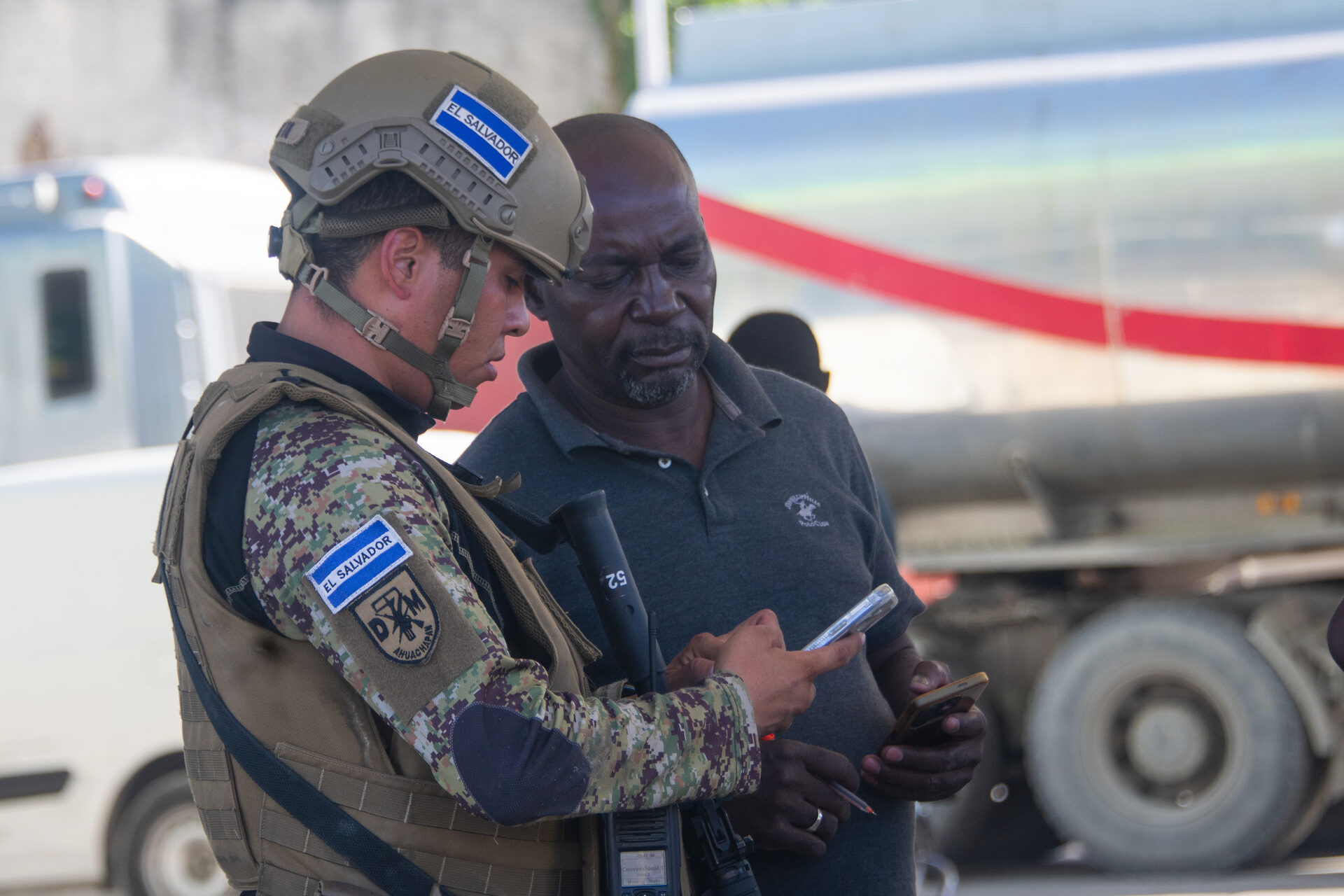
The Spanish news agency EFE reported that on Friday, Oct. 30, Salvadoran soldiers patrolled at Tabarre and at Clercine, in the Port-au-Prince metropolitan area — soldiers in combat uniform carrying assault rifles, moving in trucks and armoured vehicles, with helicopters overhead, and seen in the immediate area of the airport. That reached this page through two newsrooms, Diario Libre and Infobae, both citing EFE: one agency’s reporting carried twice, not two independent confirmations. The soldiers are there because four Salvadoran military aviation technicians attached to the Gang Suppression Force disappeared on Oct. 18 after an ambush at Santo, in the Croix-des-Bouquets district; El Salvador says it now has more than 2,000 soldiers in Port-au-Prince and has not confirmed what became of the four.
Toussaint Louverture is also the airport where removal flights from the United States have landed, including flights this page has counted this autumn. Those two facts sit in the same square mile. No source connects them: nobody has reported that any removal flight was added, delayed, moved or cancelled because of the patrols, and this page is not asserting a link nobody has made.
Now the part to read slowly, because here being wrong in either direction does harm.
On Oct. 28, an organisation called the United Nations Association of Haiti — UNA-Haití — sent an open letter to UN Secretary-General António Guterres. It is signed by Harvey Dupiton, the group’s founder and the president of its reorganisation committee, who is from Croix-des-Bouquets. It says that since Oct. 22, Salvadoran forces have attacked residential neighbourhoods in Croix-des-Bouquets, Canaan and the Plaine du Cul-de-Sac with aerial bombardment, armed helicopters and heavy weapons. “We condemn the indiscriminate bombing of innocent civilians in our country,” it says. It states that families are sheltering in their homes out of fear of the operations, and that there are children among the victims. It asks the United Nations for an independent investigation into civilian deaths since Oct. 18, for a public order halting offensive bombing operations, and for the Security Council to clarify the limits of the mission’s mandate.
Two institutions answered on Saturday, Oct. 31.
President Nayib Bukele of El Salvador posted the letter and replied to it in his own words: “Bombs? Our mission doesn’t even have bombs at its disposal. Aerial bombardments? Helicopter gunship attacks? Our attack helicopters didn’t arrive in Haiti until October 29… Yet this report was published a day before our helicopters even arrived. And as of today, they haven’t flown a single mission.” He went on to call non-governmental organisations “nothing more than lobbying firms for criminals and cartels, masquerading as humanitarian organizations.”
Shortly afterwards the Gang Suppression Force — the international mission itself — said on its own account that it does not use explosive devices and conducts no aerial bombardment in its operations in Haiti, that this covers the Salvadoran contingent and the aircraft operating under its structure, that its helicopters do not carry explosives, and that explosive devices are prohibited under its rules of engagement.
This page is not resolving that. It is a diaspora advocacy organisation’s account on one side — Diario Libre notes in its own voice that, despite its name, UNA-Haití is not part of the United Nations — and the accused parties’ denials on the other. No government, police force or international body has published a finding. The investigation the letter asks for does not exist. No reporter has published an eyewitness account from the three named neighbourhoods that would settle it either way, and this page has not seen one.
Two things follow, and they hold whichever account turns out to be right.
The first is about money. There is no investigation to join, no list to be added to, no claim to file and no compensation process. If anyone offers to register your family, your damage or a relative’s death with the United Nations, with a court, or with anybody else in connection with this, for a fee, that is a fraud. Nobody may charge you for it, because there is nothing to charge for.
The second is about the record. If your family is in Croix-des-Bouquets, Canaan or the Plaine du Cul-de-Sac and they have seen something, what is worth having is what they write down at the time: the date, the hour, the street, and what they saw with their own eyes rather than what was passed along. Only if they can do it safely — nothing here is worth anyone’s safety. If an independent investigation is ever opened, contemporaneous notes made by the people who were there are the material it runs on, and nobody can make them afterwards.
3. The road north
North of Port-au-Prince, on Route Nationale 1, armed men attacked several localities in the commune of Arcahaie early on Saturday, Oct. 31, and a second report that evening attributed the attack to an armed group known as “Taliban” and said houses were burned and people were reported killed and wounded. No exact toll has been published, and this page is not estimating one. The detail, and what remains unconfirmed, is in the feed entries for Oct. 31 above.
Route Nationale 1 is the main road between Port-au-Prince and Saint-Marc — the road a person sent back to Haiti takes to reach the Artibonite and the north. If someone in your family is on that road, call them before anyone travels, and if a journey can wait, let it wait. Nobody may charge you a fee for information about which roads are open.
4. What has not changed
TPS for Haiti and for Syria is terminated, effective July 27, 2026, and those work permits expired the same day. This page checked the government’s own pages again this morning: the USCIS Temporary Protected Status page still says exactly that, and the I-9 Central news index — the dated list of every work-authorisation release by country — still shows nothing for Haiti since July 29 and nothing for Syria at all. If anyone tells you Haitian or Syrian work permits have been extended again, that is the page that settles it, and it does not say so.
Nobody has to leave. Losing TPS is still not a judge ordering you personally to leave, and most people who lost it have no such order — but if a judge has already ordered your removal, that order did not go away, and this is the week to put it in front of a lawyer. You can check your own immigration court case free, at any hour, on the automated line at 1-800-898-7180 by A-number; it is in English and Spanish only, and if you have never had a case you will find nothing there, which is not bad news.
Find someone detained · Report an ICE sighting · Free legal help · Know your rights · Tools and checklists
Sources
- Revista Estrategia & Negocios, 'UNA-Haití denuncia muertes de civiles que atribuye a soldados salvadoreños', published Saturday, Oct. 31, 2026. Read in full to a plain desktop browser. The source for the contents of the open letter, the three named neighbourhoods, the Oct. 22 start date, the Security Council resolutions it cites, and the signature of Harvey Dupiton
- Diario Libre, 'Bukele niega que militares salvadoreños hayan bombardeado zonas civiles en Haití', published Saturday, Oct. 31, 2026. Read in full to a plain desktop browser. It carries President Bukele's post in his own English words, states in the paper's own voice that UNA-Haití is not part of the United Nations, and reports the Friday patrols at Tabarre and near Toussaint Louverture airport in the Clercine area
- Infobae, 'Fuerza de Supresión de Pandillas negó bombardeos en Haití y afirmó que el contingente salvadoreño no utiliza explosivos', by José Cerón, datePublished 2026-11-01T04:04:03Z (shown as 01 Nov, 2026 12:04 a.m. EST). Read in full to a plain desktop browser. The source for the Gang Suppression Force's own statement on Saturday, Oct. 31
- Vant Bèf Info, 'Haïti/Insécurité : des hommes armés attaquent plusieurs localités de l'Arcahaie', signed Moïse François, pubDate Sat, 31 Oct 2026 13:45:25 +0000, and 'Arcahaie : des morts et des blessés, les gangs reviennent en force', signed Uguenson Auguste, pubDate Sat, 31 Oct 2026 22:46:12 +0000. Both read in full through the paper's own feed
- The Haitian Times, 'American Airlines to resume daily Miami-Cap-Haïtien flights Nov. 1, spokesperson confirms', pubDate Thu, 29 Oct 2026 12:51:40 +0000, read in the outlet's own feed; and Le Nouvelliste, 'American Airlines reprend ses vols entre Miami et Cap-Haïtien le 1er novembre 2026', pubDate Sun, 01 Nov 2026 04:10:20 GMT. The Nouvelliste article's own page could not be opened from here today — its homepage and sitemap were both lagging — so only its headline and publication time were read
- USCIS — Temporary Protected Status, read twice with differently worded prompts on Nov. 1, 2026 (page stamped Last Reviewed/Updated 10/20/2026). Haiti and Syria each 'terminated, effective July 27, 2026'; the countries listed as designated are El Salvador, Lebanon, Sudan and Ukraine; the page announces no pause of removals for any country
- USCIS I-9 Central, Form I-9 related news, read Nov. 1, 2026. The most recent Haiti item is dated July 29, 2026, and there is no Syria item; nothing extends any Haitian or Syrian work permit
Community discussion
Comments are moderated before they appear. Never share your A-number, address, or case details here, and never trust legal advice from comments — talk to a licensed attorney (free help here). Comments are provided by GraphComment (EU-hosted, GDPR-compliant) and are optional.