The Ankle Monitor: What ICE's Own Numbers Show, What the Device Decides, and What to Do If You Are Wearing One
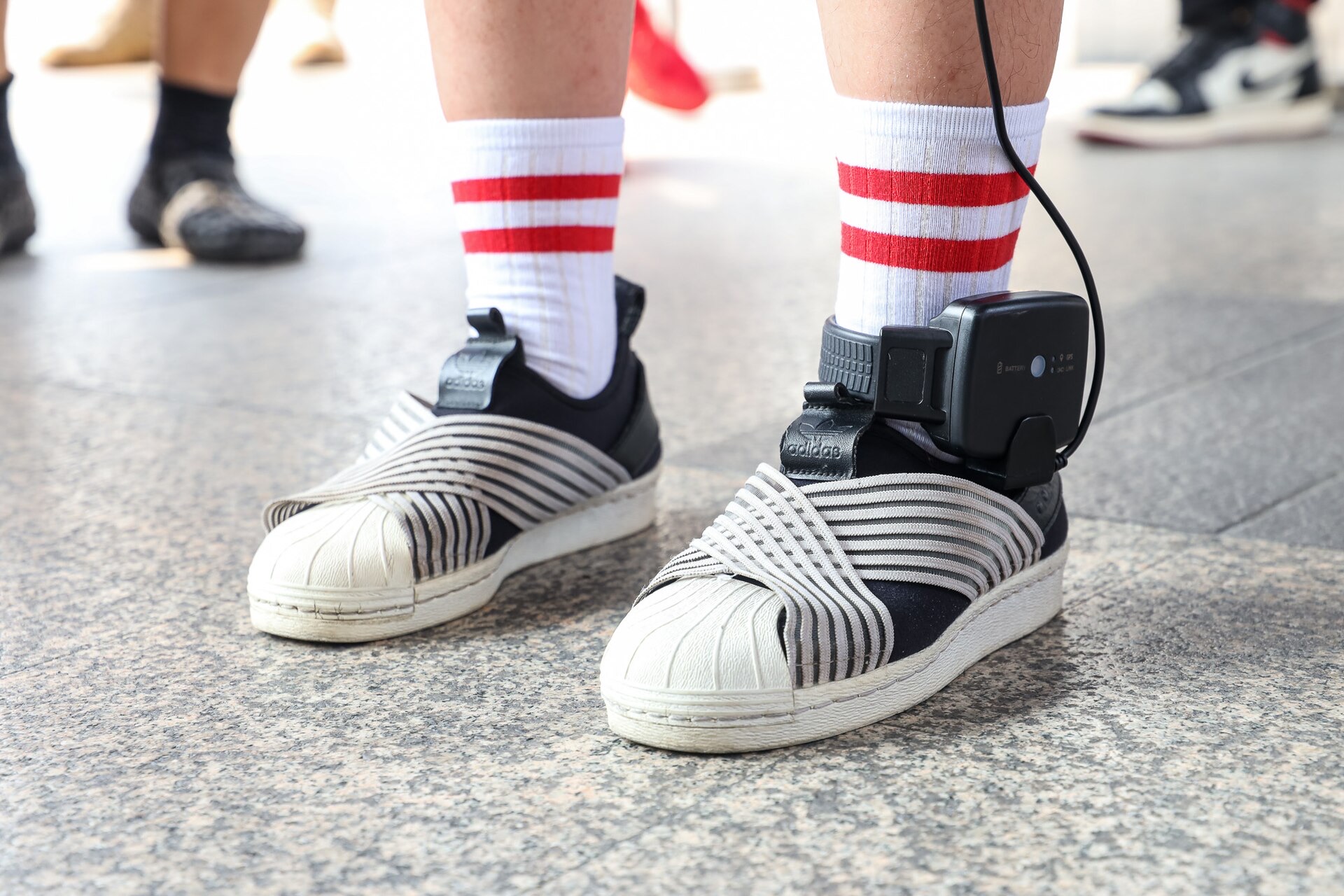
More people in this country are wearing an electronic monitor on their ankle than at any point in the program’s history, and almost nobody wearing one has been told what it means. It is not a sentence. It is not a decision about your case. This week ICE’s own published statistics made clear what it is — a change in method, not a change in scale — and the agency itself has now written down, in a sentence worth reading twice, what the device says about the person wearing it.
Start with the numbers, because they are the government’s own and because they say something different from what the headline says.
What ICE’s own statistics show
WCPO 9 News in Cincinnati (Jay Shakur, Sept. 3) went through ICE’s published detention statistics. The number of people wearing an ankle monitor under the agency’s Alternatives to Detention program went from 30,249 in fiscal year 2025 to 53,192 in fiscal year 2026 — a rise of nearly 76%.
Read the next figure before you decide what that means. Over the same year, the overall Alternatives to Detention population barely moved: 181,210 to 183,181, about 1%. Ankle monitors went from roughly 17% of everyone being monitored to nearly 29%. Most people under supervision are still checked on through the SmartLINK phone app, not a device on the leg — but the ankle monitor grew faster than any other method.
So ICE is not supervising many more people than it was a year ago. It is putting a much larger share of the same population into a physical device. That is a change in method, and the method is precisely what clergy, families and a coalition in Springfield have spent three weeks asking the government to change.
Three limits on those figures, and all three matter. They are nationwide totals covering every nationality. They are not a count of Haitians, they are not a count of Springfield, and the reporting gives no breakdown by country or city. Do not read them as a measurement of what is happening to your community — read them as a measurement of what the agency has decided to do generally.
One more number from the same reporting, which cuts against the reason usually given for the device: ICE told the station that court appearance rates for people under monitoring stayed around 98% in both years.
How a monitor actually gets onto someone
This page has followed the mechanism since the end of July, and it is consistent enough to describe plainly.
It usually begins with a letter. Since TPS ended, Haitian families around Springfield, Ohio have received DHS letters telling them to report in person to an ICE office — Blue Ash, outside Cincinnati, or Westerville, outside Columbus, each about an hour’s drive away. People go, and many come out wearing a GPS monitor and carrying an instruction not to travel more than about 75 miles from home. Others are fitted with one after being detained and released. The New York Times watched this happen in August: a 35-year-old man walked into the Blue Ash office carrying an active asylum petition and a work permit valid until 2029, and came out about 90 minutes later with a monitor on his left ankle and a date to report back.
Paperwork in progress did not prevent it. That is the pattern this site has now published many times, and it is why the monitor is best understood as a condition of supervision rather than as a verdict on anybody’s file.
ICE has said as much itself, on the record, and it is the most useful sentence the agency has given this story. Answering the Springfield News-Sun about Pierre Damas Bel — the 20-year-old Wright State student who died on Interstate 70 on Aug. 31 — an ICE spokesperson said that on July 29 the agency “placed him on alternatives to detention program with an ankle monitor while he continued in his immigration proceedings.”
While his case was still going. That is the agency’s own description of what the device is for.
What is claimed, and what is verified
Verified: the statistics above; the letters and the offices; the 75-mile instruction; ICE’s own account of why a monitor is applied. Verified too is what people say the device is doing to them — the Springfield News-Sun reported on Sept. 1 that hundreds of local Haitians have been fitted with monitors and that many report pain, swelling and blisters, or trouble holding a job. Bel’s friend Yola Lamarre said at a Columbus vigil that the device kept him off the soccer field, because a ball striking it would knock the battery loose and alert federal agents: “It wasn’t just a bracelet. It was bondage.”
Claimed and not confirmed: some details around that death remain contested and the Ohio State Highway Patrol’s investigation is open. His father has said he does not believe his son took his own life and wants to see proof; his pastor says the family wants it known as a suicide. The News-Sun reported the father’s account that his son was denied a JROTC uniform because of the device, and said plainly that it had not independently verified it. This site is not going to resolve any of that, and neither should anyone acting on it.
What the government has said about the future is not ambiguous. On Sept. 4, at a roundtable in Lebanon, Ohio, Homeland Security Secretary Markwayne Mullin said ICE will keep using ankle monitors on Haitians who came under TPS — a direct answer to the demand a Springfield coalition made on Aug. 28 — and, asked about Bel’s death, said “it breaks my heart for the parents, but we were following our procedures.” Two days earlier, asked four specific questions by the News-Sun — why Bel was fitted with a monitor, whether he was considered a flight risk or a safety threat, whether he had reported distress about it, and whether the agency was reviewing his supervision — ICE answered none of them.
Ohio’s governor, Mike DeWine, called the arrests of people like Bel “a mistake.” A governor cannot stop a removal and that statement changes nothing in anyone’s case. What it does is tell families in Clark County that they are not imagining the harm.
What has not changed
Losing TPS is not a deportation order. It never was one, and nothing in this article makes it one.
A monitor is not a conviction. It is not a finding of guilt, it is not a decision by an immigration judge, and it is not an instruction that you leave the country. Wearing one does not mean your case has gone badly, and not wearing one does not mean it has gone well. Your hearings decide your case. The device does not.
And the necessary exception, because it is real for a minority of readers: if an immigration judge has already ordered your removal, that is a separate matter and it does not go away because a monitor is not a verdict. See a lawyer about it this week.
What to do this week
- Take the paper ICE handed you to a lawyer. The conditions you were placed under — the reporting date, the travel limit, what happens if the battery dies — are written on it. Free legal help is at /help/.
- Ask your lawyer to file to have it removed. In Springfield, volunteers at the Haitian Support Center have been filling out requests asking an immigration judge to authorize taking monitors off people with medical conditions and other problems. Do not try to remove it yourself.
- Report pain and injury every single time, and write down the date you reported it. If the device is causing broken skin, swelling or a lost shift, say so at each check-in and tell your lawyer, so there is a written record somebody can use later.
- Do not miss a check-in, and find out where your case actually stands. You can check your own immigration court case for free at EOIR’s automated line, 1-800-898-7180, 24 hours a day, using your A-number — it gives your next hearing date and any judge’s decision. Two limits: the line is in English and Spanish only, so have someone who can interpret sit with you, and a person who has never had a case in immigration court will find nothing there. That is normal, and it is not bad news.
- Make the plan you hope you never use. Decide now who collects your children, who holds your papers, and who gets called first — /tools/ walks through it. If someone stops answering, start the search that night at /find-someone-detained/.
If today is hard, 988 answers 24 hours a day. Call rather than text if you need another language, and say the name of the language when they pick up: 988’s own FAQ says it connects an interpreter in more than 240 additional languages, by voice call only, in about 20 seconds. Haitian Creole is not listed by name, so ask for it, and have someone sit with you if you can.
The last thing, and it is the one this page most wants you to take: a monitor is a reason to make sure your case is being fought, not a reason to conclude it is over. It tells you the government is watching. It tells you nothing at all about how your case ends.
Sources
- WCPO 9 News (Jay Shakur) — ICE's published detention statistics on ankle monitors and Alternatives to Detention (Sept. 3, 2026)
- Springfield News-Sun (Jessica Orozco) — ICE's account of the student placed on alternatives to detention, and its refusal to answer four questions (Sept. 1 and Sept. 3, 2026)
- Cincinnati Enquirer (Scott Wartman and Mia Hilkowitz) — the Homeland Security secretary says ICE will keep using ankle monitors (Sept. 4, 2026)
- U.S. Department of Justice, EOIR — Automated Case Information, 1-800-898-7180 (check your own immigration court case)
- 988 Suicide and Crisis Lifeline — FAQ on language interpretation for callers
Community discussion
Comments are moderated before they appear. Never share your A-number, address, or case details here, and never trust legal advice from comments — talk to a licensed attorney (free help here). Comments are provided by GraphComment (EU-hosted, GDPR-compliant) and are optional.